

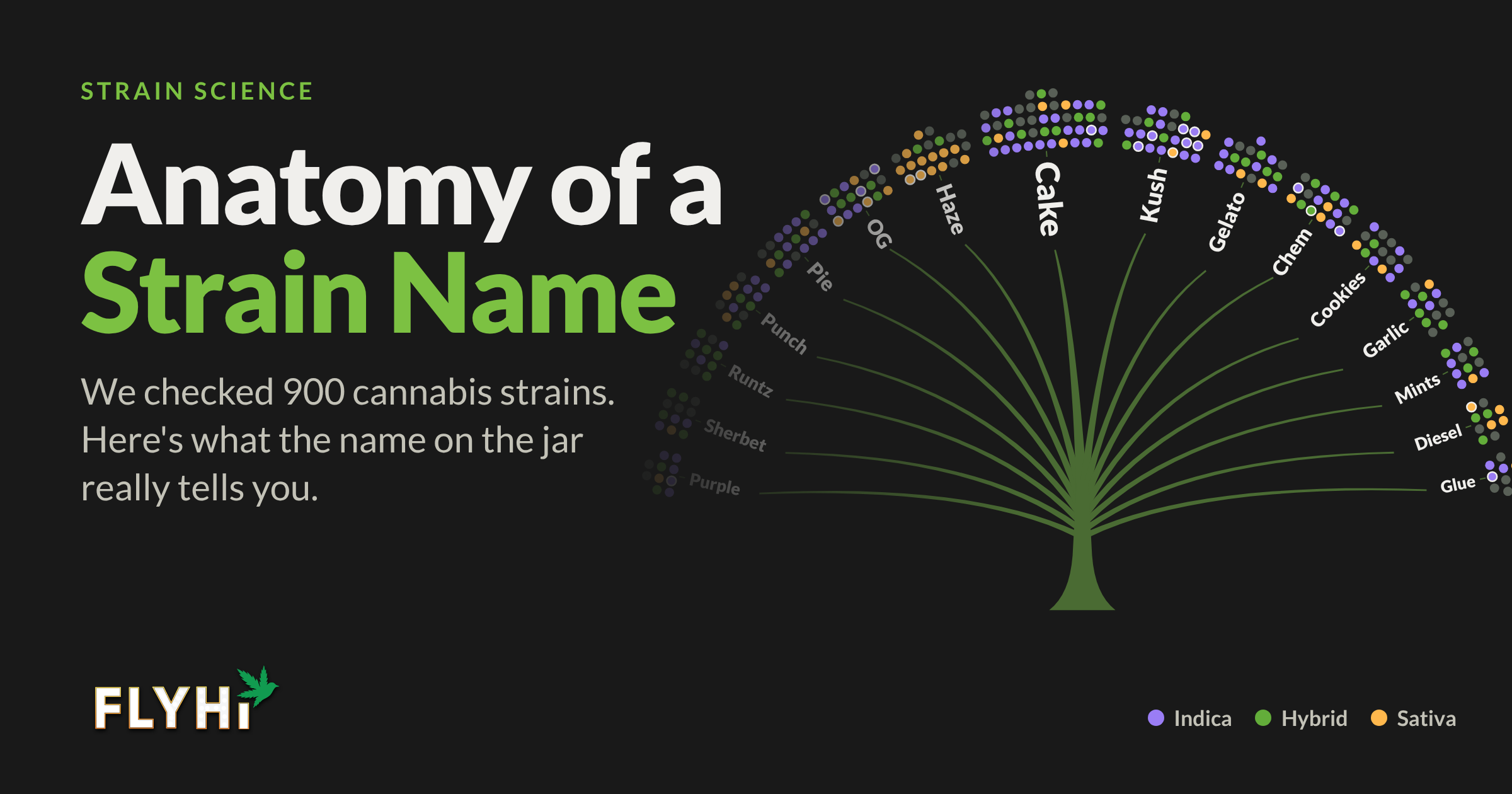

Anatomy of a Strain Name
What 900 cannabis strains and over a decade of our own menus taught us about the words on the jar.
By Steve P · November 2026
I've been enjoying cannabis for 35 years, and I have one complaint. Every time I find a strain I love, it's gone in a month. In its place there's another Cake, or something that ends in Z.
I just want the same good weed more than once or twice. I don't want to be the test mule.
So I did something a little obsessive. I went back through every strain name that has crossed our Colorado dispensary shelves since 2014 (back when it was Euflora), cleaned out the typos and duplicates, and counted. We've carried about 900 strains more than once. Well over a thousand more showed up one time and never came back.
Then I looked up what's published about each one: the type, the parents, who bred it. I wanted to know if a strain name tells you anything at all.
It does. Just not as much as the jar wants you to think.
How a cannabis strain name gets built
Most strain names follow a formula. Two out of three are exactly two words: a flavor, then a family name. Lemon plus Cake. Grape plus Pie. Sour plus Diesel.
Our six most common first words and six most common last words. That makes 36 possible names, and 17 of them have been on our shelves at some point.
The first word is usually something you'd find in a produce aisle. The last word works like a surname. It's supposed to tell you what family the strain comes from.
Here's the thing most won't tell you at the counter. There are no rules. When a grower gets a cutting from somebody, nothing stops them from keeping the name, tweaking it, or making up a new one over a joint. A scientist at Leafly put it better than I can: a farmer can't just pick up an apple and decide to call it a Golden Delicious. With weed, you can.
Then vs now
When we started, about one in ten strains on our menu had Kush in the name. Today it's about one in fifty. OG and Diesel fell off the same cliff.
What replaced them was dessert. Names built on cake, pie, cookies, gelato and candy went from about 3% of the menu to about 16%. Cake alone went from almost nothing to one in every twenty strains. Names ending in Z went from basically zero to more than one in twenty.
Over the years, Kush has been on 88 different strain names in our system. Cake is already on 101. Kush took a decade to get there. Cake passed it in a few years.
Gelato and Runtz are doing now what Kush did back then. They've become surnames you can stick a flavor in front of: Cherry Gelato, Guava Gelato, Pink Runtz, White Runtz. And then there's Garlic, which is on 14 strains we've carried more than once. Nobody in the early days would have put that word on a jar. But, I may have been inclined to add it to my homemade tabouli.
But the name change isn't the big story. This is.
Each square is 1% of the strains we've carried more than once. The empty ones have no published record.
That's about a third of the strains we've carried more than once. I checked every place I know to look.
Back then, most strains on the menu came with a history. Today a lot of them are just a name on a jar.
The strain name cheat sheet: indica or sativa?
In theory the surname tells you which way a strain leans. Kush should be indica. Haze should be sativa. So I checked every name against what's actually published about the strain.
Quick note on terms. Almost nothing is pure indica or pure sativa anymore. So when a word lands in the indica box, it means strains with that name are usually indica-dominant hybrids. Same idea for sativa.
A few things surprised me.
Not one Z strain we could check leans sativa. Zero for 29. Same goes for Runtz, zero for nine.
OG barely tells you anything. It leans indica a little, but about one in four turns out to be a sativa. It used to mean something.
And when a name mixes signals, like a sativa word with an indica word, it's a coin flip. Lemon Cake leans sativa. Key Lime Pie leans indica. Lemon Pound Cake sits in the middle.
Overall, when a name carries a clear signal, it matches the strain's published type about six times in ten. It points flat wrong about one time in ten. The rest land in the middle.
So the name is a decent hint. It's not a promise.
Science backs that up. In 2021, researchers DNA-tested over a hundred cannabis samples and found that strains labeled indica and strains labeled sativa were basically indistinguishable across the genome. The only real difference showed up in a handful of terpenes, the compounds that give weed its smell. In other words, indica and sativa are more about how a strain smells than what it is.
Indica vs sativa: what actually makes one an upper and one a downer?
Honestly? Nobody has fully nailed it down.
Indica and sativa started as words for how the plant looks. Short and bushy, or tall and skinny. Somewhere along the way they turned into words for how it hits.
The best guess right now is terpenes, the compounds that give weed its smell. The earthy, musky ones get blamed for couch lock. The citrus and pine ones get credit for the lift. That matches my 35 years of experience pretty well.
But most of it has never been tested on actual people. One of the only real studies, from Johns Hopkins in 2024, found that adding the citrus terpene limonene to THC made people feel less anxious and paranoid. Twenty people. That's about where the science is.
What I can tell you is that dose sometimes matters as much as the label.
A little is a lift. A lot is a nap. And your nose is a better guide than the jar.
Everything is a hybrid now
Of the strains we've carried that have a Leafly page, four out of five are labeled Hybrid. Only about one in ten is labeled Indica, and about one in ten Sativa.
But "hybrid" hides a lot. Most hybrids aren't 50/50. They're indica-dominant or sativa-dominant, and that's the part that tells you something. AllBud breaks it out, and the picture changes.
So about two out of three "hybrids" still lean hard one way. Only a third really sit in the middle.
Pure strains are close to extinct. Out of those 456, only nine are listed as straight indica or straight sativa. Northern Lights, Afghani and Kosher Kush are on that short list.
Sativas are getting squeezed the hardest. Only about one in five strains we've carried leans sativa. Of our 60 most-stocked strains, just 13 do, and they're mostly the old ones: Sour Diesel, Blue Dream, Golden Goat, Durban Poison, Jack Herer.
I miss the days when you could get a real landrace, a strain that grew in one part of the world for centuries and never got crossed with anything. So where did they go?
They got bred into everything else. Researchers at the University of Northern Colorado said it plainly: decades of intense breeding merged the two types and blurred the line between them. A landrace sativa takes a long time to flower and doesn't yield much. A hybrid finishes faster, tests higher and fills more jars. You can guess which one pays the light bill.
A big 2022 study out of CU Boulder looked at nearly 90,000 lab-tested samples from six states and found the same thing from the chemistry side. Legal cannabis sorts into three groups based on terpenes, and none of the three lines up with indica, sativa or hybrid. Their conclusion was that the labels have only a loose connection to what's in the jar.
The one-hit wonders
About two out of every three strain names we've ever stocked showed up on exactly one product and then disappeared.
I figured the one-hit wonders would be the trendy names, the Cakes and the Z's. They're not. I compared them to the names that stuck around, and they look the same. Same share of fruit names, same share of dessert names. You can't spot a one-hit wonder by reading the label.
What you can do is look at where they show up. Most of them aren't flower. They're wax, live resin, carts and infused pre-rolls. That makes sense once you know how extracts get made. An extractor often runs whatever material they can get that month, and the name comes along for the ride. Next month it's different material and a different name.
There's one more pattern. The strains with a real paper trail are the ones that come back.
Strains we carried exactly once
These are real. I didn't make any of them up, though somebody did.
The survivors
Now for the other end of the list. A few dozen cannabis strains show up on both our earliest menus and our current one. You know most of them: Durban Poison, Jack Herer, Golden Goat, Chemdawg, OG Kush, Trainwreck, White Widow, Grape Ape, Strawberry Cough, Ghost Train Haze.
Here's what they have in common. They're the opposite of the modern menu.
Of the survivors we could check, 41 out of 46 are clearly indica-dominant or sativa-dominant. The strains that last are the ones that are clearly something. You know what you're getting with Durban. You know what you're getting with Grape Ape. That's why people keep asking for them.
The name tree
Here's every big family of strain names we've carried, in one picture. Every branch is a surname. Each leaf is a strain we stocked more than once. Tap a branch or a leaf.
The newer strains have a family tree too, and it's a small one. When I traced the parents of the modern menu, the same names kept coming up: Girl Scout Cookies, Wedding Cake, Zkittlez, Gorilla Glue and Gelato. Funny thing about Girl Scout Cookies, or GSC as it's usually labeled now. We've only carried it under its own name a handful of times. Its real footprint is in the bloodline of a big share of everything else we sell.
So what happened to my personal all-time favorite, Green Crack?
I asked this online and got a straight answer from a grower. It got popular, everybody grew it, everybody got sick of it.
But it never fully left. It's been on our shelves in both eras. What it did do is turn into a surname. We've carried Cherry Crack, Guava Crack, Mango Crack and Gas Crack Cookies. The original is still out there. It just has a lot of cousins now.
I personally like consistency, not being a test mule. But I'm in the minority.
So why do growers keep chasing new strains instead of perfecting one?
I put that question to people in the industry online, and most of them pointed right back at me. Well, at us. Customers want variety, they said. New strains sell. One told me he's never met a customer who asks for the same flavor every time.
The most honest answer was also the shortest. They grow what sells high, yields high and tests high. When any of those three starts slipping, the next strain comes in.
Another compared it to the McRib. You pull a popular strain off the menu on purpose, wait, and bring it back so people get excited again. I can't even be mad at that one.
I get it. It's a business. But I'm not the only one who would happily smoke the same four strains all year. We're the minority, just maybe not as small a one as growers assume.
Here's the part that stung a little. Even when you do find your old favorite, it might not be your old favorite.
A few years back, a researcher at the University of Northern Colorado walked into dispensaries as a regular customer, mostly here in Colorado, and bought the same strains at different shops. Then she DNA-tested them. Out of 30 strains, only four were the same plant everywhere she bought them.
Nine jars of Durban Poison from nine shops. Seven were the same plant. Two were something else with Durban Poison on the label.
Durban Poison is the one that got me. One shop in that study was also selling two different OG strains that turned out to be the identical plant in two jars.
It wasn't all bad news. Almost every Chemdawg sample was closely related, which fits the old story that it all traces back to one bag of seeds from a Grateful Dead show. And Golden Goat tested as a relative of Island Sweet Skunk, which is exactly what its breeders have always said.
So the real thing is out there, and when you find it, it's stable. The name on the jar just can't promise you that by itself.
So what do you do with all this?
A few things I've started doing myself.
If you want to see where your favorite fits, our list of the greatest strains of all time is a good place to start. Or come in and ask us what's on the shelf right now that has a real family tree. We'll tell you straight.
Our data. Every cannabis strain name from our dispensary's point-of-sale records, cleaned up by hand to merge typos and duplicate spellings. The numbers in this post cover the roughly 900 strains we've stocked on more than one product. Type and parent information comes from each strain's published profile on Leafly, SeedFinder or AllBud, plus strains we researched ourselves, or our own greenhouses.
Studies.
- The phytochemical diversity of commercial Cannabis in the United States, PLOS ONE, 2022.
- Cannabis labelling is associated with genetic variation in terpene synthase genes, Nature Plants, 2021.
- Genetic tools weed out misconceptions of strain reliability in Cannabis sativa, Journal of Cannabis Research, 2019.
- Vaporized D-limonene and the anxiety effects of THC, Drug and Alcohol Dependence, 2024.